I don’t think AI doing 95% of the work is necessarily a problem. In some cases, that’s exactly what I want.
In others, that same arrangement produces work I wouldn’t put my name on.
You can’t tell the difference by counting how many words the human wrote or how much time they spent. You can even require a person to review and approve everything, and still end up with either result.
That’s what interests me about “human in the loop.” We talk about it as a requirement, but it can describe very different ways of working.
I think there are four worth separating. And the distinction starts before anyone clicks approve.
What kind of work are you handing over?
Consider two requests.
“Help me write an article about a problem I’ve spent years working on.”
“Review this document against these requirements and flag potential issues.”
Both might produce several pages of text. Both need a human involved. But what makes the result valuable is different.
The article needs something from the writer: experience, an argument, a way of looking at the problem. The review needs someone who understands the requirements and can judge whether they’ve been addressed.
That gives us two things to consider: where the work falls between creative and rules-based, and the strength of the human contribution.
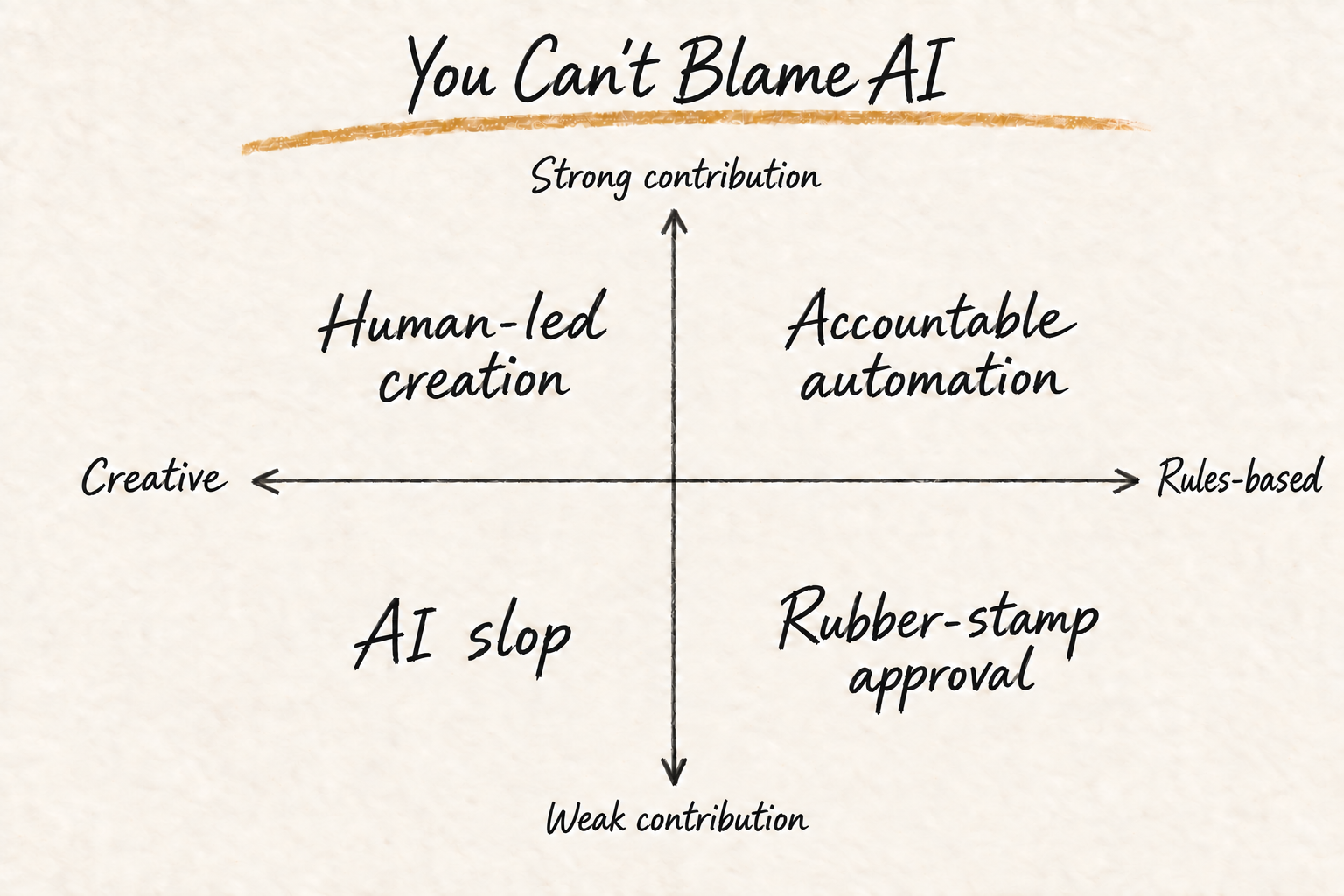
Contribution here means the ideas, expertise, and attention you bring to the work. It isn’t a count of hours. An experienced person may check something quickly because they know exactly what to look for. Spending longer wouldn’t necessarily improve it.
1. Human-led creation
For a piece of writing that represents someone’s thinking, the ideas need to come from the writer.
AI can help with a lot of what happens around those ideas. Ask questions. Challenge the argument. Find a gap. Improve the organization. Help explain something the writer understands but hasn’t articulated clearly.
The approach I find useful is to give it much more than the finished piece needs. Here are the experiences, examples, doubts, and connections. Here’s what I think, including the parts I haven’t figured out yet.
Give it 1,000% and distill that down to 100%.
That can produce something better than the writer would have put together alone. The substance still comes from them, and they’re making the decisions about what the piece says.
For a review, AI can do most of the initial work, and the human’s expertise comes through in checking it. For writing that represents your thinking, that contribution needs to come earlier. You need to give it something worth shaping.
2. AI slop
Sometimes a short prompt is enough. I don’t think every sentence needs a long creative process behind it.
But a piece that’s supposed to demonstrate your experience or express your point of view asks more of you.
If your contribution is a sentence, and AI supplies the argument, examples, and conclusion, agreeing with the result doesn’t add much. You may like what it says. It may even be correct. But what is the reader learning from you?
To me, that’s where a lot of AI slop comes from. The person has delegated the thinking that would have made the piece worth reading.
You can edit the language until it sounds natural. You can remove every phrase that makes it sound AI-written. The absence of substance from the writer is still there.
For this kind of work, human involvement needs to start well before the final review.
3. Accountable automation
A review has a different purpose. You’re checking work against requirements, using expertise to identify errors and omissions.
AI can do substantial initial work here. It can review a document through a particular lens, suggest redlines, or flag issues for further examination. If it covers everything a qualified reviewer needs it to cover, great. Sign off and move on.
But someone needs to know whether it covered everything.
Think about a paralegal preparing work for an experienced lawyer. The lawyer gets a lot of value from delegating the initial work. They don’t have to repeat every step. Their expertise lets them assess the result, question an assumption, and notice something the assistant missed.
That expertise is what makes the arrangement work.
My rule of thumb for AI is the same: the person signing off should be capable of doing the work without it.
That doesn’t mean doing the work twice. It means knowing what a complete, correct result requires.
A review can be accurate in every issue it raises and still miss the most important issue. A qualified person can look beyond the findings presented to them and ask what else should have been considered.
If you take the time saved as evidence that you no longer need that expertise, you’ve missed why the arrangement worked in the first place.
4. Rubber-stamp approval
Now give that same review to someone who isn’t equipped to evaluate it.
They read the findings. The reasoning sounds plausible. Nothing obviously contradicts anything else. They approve it.
What has the approval established?
It tells you the person agreed with what they read. It doesn’t tell you whether the review was complete or whether the conclusions hold up.
You can get to the same place with a qualified reviewer who stops paying attention. The last few results were good. This one looks similar. Approve.
I don’t think that’s anyone’s vision of a human-in-the-loop process working well. Yet the approval record may look exactly the same as it would after a careful review.
Requiring someone to confirm each finding can help. It gives the review a structure and makes the expectation explicit. But someone who wants to click through will probably find a way.
The process needs a person with the expertise to challenge the output and the attention to actually do so. A button can record their decision. It can’t supply their judgment.
Strong reviewers are key
The useful thing about this arrangement is that AI doesn’t have to get everything right on the first pass for the process to produce good work.
If the output is good, a strong reviewer can verify it and move it along. If it has problems, they can catch and correct them. Both are productive uses of AI.
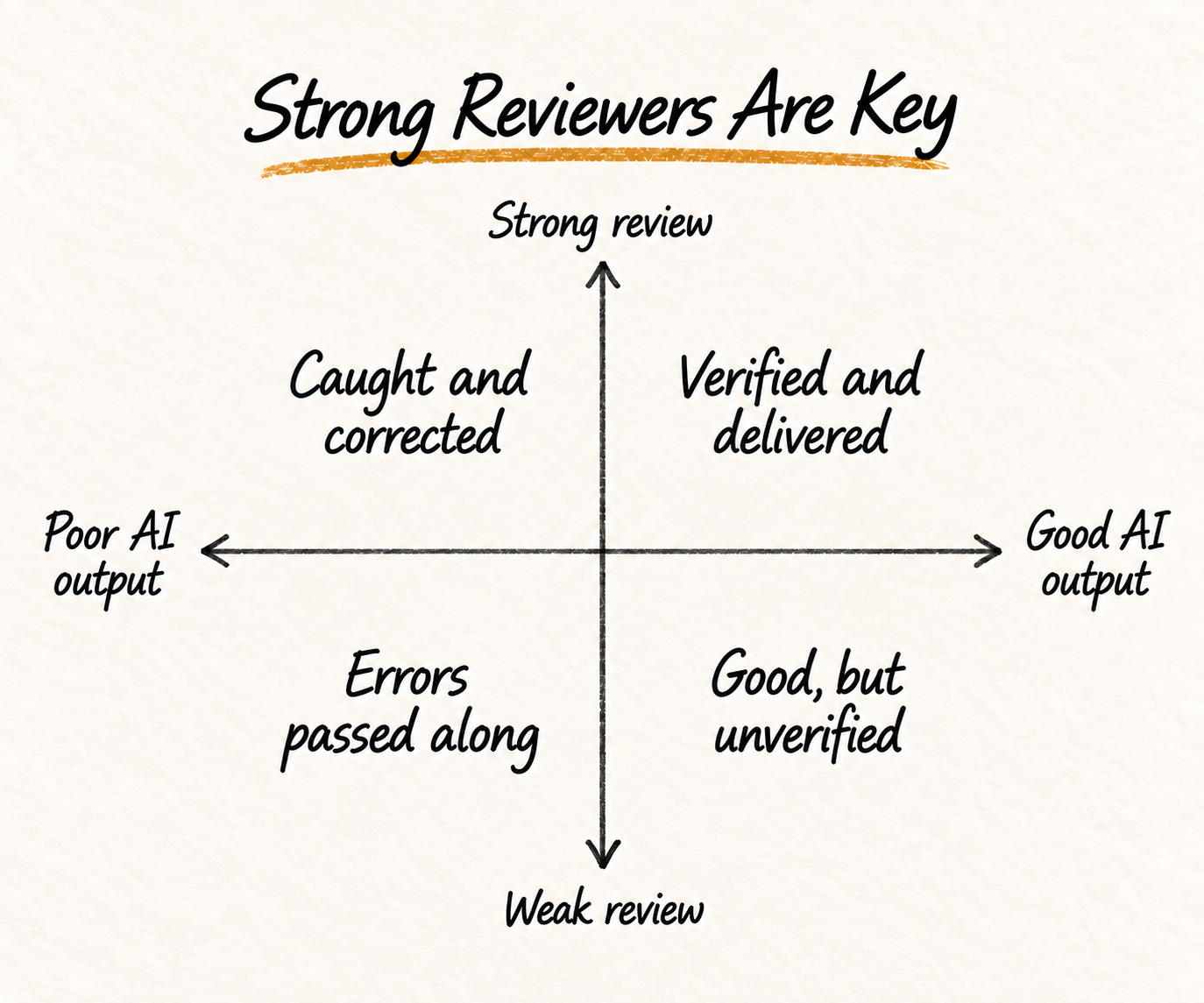
Three of these quadrants can end with good work. Even a weak review can pass along a correct result. But in that case, the review hasn’t established much. You’re depending on the output already being good.
The failure happens when poor output meets weak review and the errors pass through.
That’s a reason to put capable people in the process. They can make use of good AI output and do something about the rest. The opportunity is substantial: more initial work gets done, and someone with expertise directs their attention to what needs it.
AI is an amplifier
Give AI to someone who takes ownership, and they can examine more possibilities, challenge their thinking, and get through initial work faster.
Give it to someone who wants to do the least possible, and they can produce more work than ever without putting much thought into it. Their output can look finished before they’ve understood it. Now there’s more of it moving through the organization.
That person becomes a bigger liability.
You get to choose who you want on your team. I think that choice matters even more than it did a year ago.
Who investigates when something doesn’t quite fit? Who catches the omission? Who is willing to say the work isn’t ready, even when it would be easy to pass it along?
AI gives more people the ability to delegate substantial work. They need to take the supervisory part seriously, too. You don’t need to have performed every step, but you should be able to explain and stand behind the result.
If you approve it, it’s as if you did it.
You can’t blame AI.